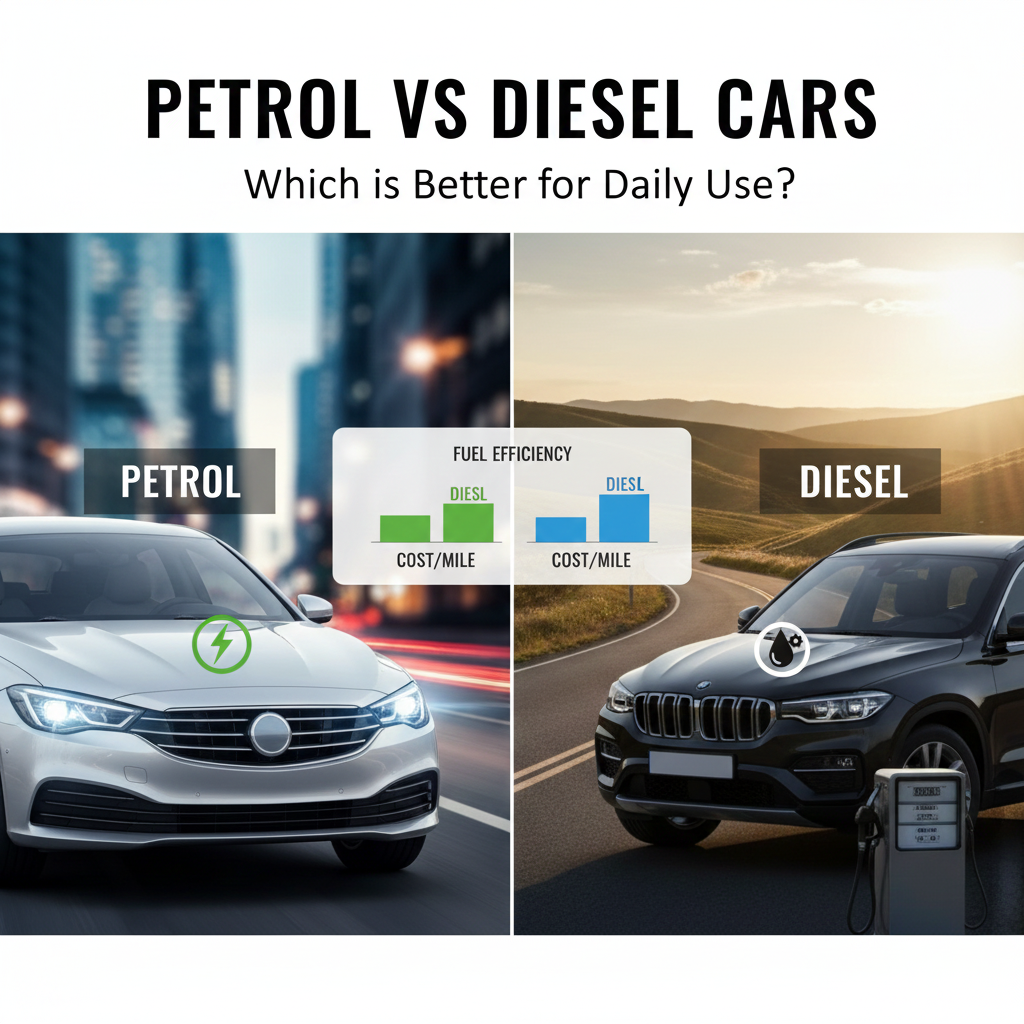
Petrol vs Diesel Cars: Which is Better for Daily Use?
Choosing between a petrol and diesel car for daily use can significantly impact your long-term expenses, driving comfort, and maintenance experience. Many first-time buyers make this decision based only on fuel price, but the smarter approach is to evaluate your daily driving pattern, distance, and budget.
This guide explains the petrol vs diesel debate in a clear, practical way to help you choose the best option for your everyday needs.
Petrol Cars – Ideal for Light and City Driving
Key Benefits
- Lower initial purchase price
- Smooth and quiet engine performance
- Better for stop-and-go city traffic
- Faster engine warm-up
- Affordable servicing and spare parts
- Low maintenance complexity
Limitations
- Lower mileage compared to diesel
- Higher fuel consumption on long trips
- Not cost-effective for heavy daily usage
Best suited for:
- Office commuters
- City drivers
- Low annual mileage users
- First-time car owners
Diesel Cars – Best for Long and Heavy Usage
Key Benefits
- Higher fuel efficiency
- Better performance on highways
- Strong torque for long drives
- Lower cost per kilometer for high usage
- Longer engine lifespan under heavy use
Limitations
- Higher purchase price
- Expensive repairs and servicing
- Noisier engine
- Higher insurance premium
Best suited for:
- Long-distance commuters
- Highway drivers
- Commercial or high-usage owners
Daily Use Comparison: Petrol vs Diesel
For City Driving
- Petrol cars perform better
- Smoother in traffic conditions
- Less engine strain for short trips
For Long Commutes
- Diesel cars are more economical
- Better mileage reduces running costs
- Ideal for frequent highway travel
Cost Breakdown for Daily Users
Initial Cost
- Petrol cars are 10–20% cheaper
- Diesel vehicles require higher upfront investment
Fuel Economy
- Petrol: Lower mileage
- Diesel: Better fuel efficiency
Maintenance Cost
- Petrol: More affordable servicing
- Diesel: Higher service and repair costs
Mileage Rule for Smart Buyers
Choose Diesel only if:
- You drive more than 15,000–20,000 km per year
Choose Petrol if:
- Your annual usage is below 12,000 km
This simple calculation helps reduce unnecessary ownership costs.
Maintenance Comparison
Petrol Cars:
- Simple engine construction
- Budget-friendly servicing
- Easy availability of spare parts
Diesel Cars:
- Complex fuel systems
- Requires specialized maintenance
- Higher long-term repair expense
Environmental Impact
Petrol Cars:
- Lower nitrogen oxide emissions
- Higher carbon emissions overall
Diesel Cars:
- Better fuel efficiency
- Higher particulate emissions
Many cities are also introducing stricter regulations for diesel vehicles.
Which One Should You Choose?
Choose a Petrol Car if:
- Your daily commute is under 40–50 km
- You mainly drive in city traffic
- Your budget is limited
- You prefer low maintenance costs
Choose a Diesel Car if:
- You travel long distances every day
- You frequently use highways
- You want better mileage
- Your yearly usage is high
Quick Decision Table
| Driving Pattern | Better Choice |
|---|---|
| Short city commute | Petrol |
| Heavy highway travel | Diesel |
| Budget-friendly option | Petrol |
| Long-term fuel savings | Diesel |
Common Mistakes to Avoid
- Choosing diesel for low usage
- Ignoring maintenance and service costs
- Focusing only on fuel price
- Not calculating annual driving distance
My take: EV vs Diesel — Which is better?
There’s no one-size-fits-all answer — whether a Electric Vehicle (EV) or a diesel car is better depends heavily on your driving habits, budget, and infrastructure in your area. That said, based on current trends in India (2025), I’d lean toward EVs being the better long-term choice for many buyers. Below are the pros, cons, and conditions for both.
Why EVs are increasingly attractive
- EVs have the lowest running cost among fuel types: one source says they run around ₹1-₹1.5 per km in India, versus ₹7-10 per km for petrol/diesel. (Trade Brains)
- Zero tail-pipe emissions; helps reduce urban pollution and may benefit from future regulation. (ParkSmart)
- Technology and infrastructure are improving: better battery, longer ranges, more charging stations. (ParkSmart)
- Future-proofing: Governments are promoting EVs, so incentives, subsidies, and resale viability may improve.
The caveats with EVs
- Higher upfront cost compared to a similarly sized diesel car. (Spinny)
- Dependence on charging infrastructure—if you live where charging is inconvenient or slow, it’s a disadvantage.
- If you frequently travel in remote areas or long highways and charging stations are few, EV may not yet match diesel for convenience.
- Resale value of EVs in some markets is still uncertain (though improving).
Why diesel cars still make sense (in some cases)
- High fuel efficiency for long distances / heavy usage. One article says diesel still offers good mileage on highways. (Trade Brains)
- Established refuelling infrastructure everywhere; you won’t worry about “where to fill” as much.
- For high annual kilometers (say > 20,000 km) and heavy use, diesel can offer lower cost per km (depending on other factors).
Why diesel might be declining
- Running costs and maintenance can be higher.
- Environmental regulations are tightening (especially in cities). Diesel might face restrictions.
- Future-proofing is weaker vs EVs: as EV infrastructure and market shift increases, diesel may face resale, regulatory, cost pressures.
My Recommendation: Which should you pick?
Here’s a practical decision guide:
- Choose EV if:
- Your daily driving is moderate to high but within a well-supported EV infrastructure (charging at home/work).
- You drive mostly in the city or on regular shorter/mid-length trips.
- You want lower running costs and are okay with higher purchase cost.
- You care about environmental impact or want “future-proof” choice.
- Choose Diesel if:
- You travel long distances frequently (highway usage) and charging infrastructure is weak where you travel.
- You clock very high annual mileage and want immediate lower cost per km.
- You prefer lower upfront cost compared to an EV in your budget range (though EV cost is reducing).
Final Recommendation
There is no single winner in the petrol vs diesel comparison for daily use. The right choice depends on your personal driving habits and financial planning.
Petrol cars are best for short city commutes and budget-conscious users.
Diesel cars are more suitable for high-mileage drivers seeking long-term fuel efficiency.
The smartest decision is based on your daily usage pattern, not just the fuel cost per liter.